
Blanche and Clayton Own This Mess
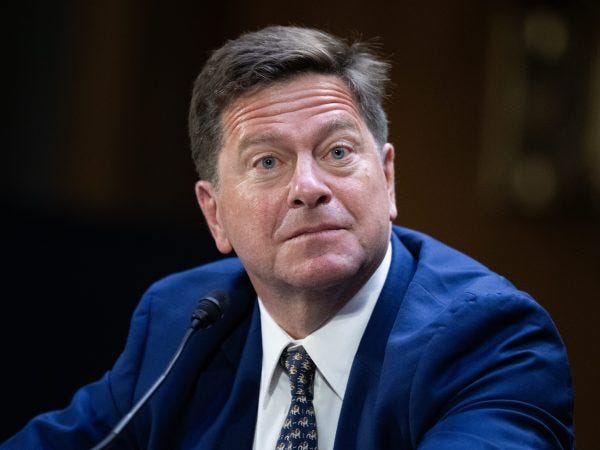
The responsibility for the Trump DOJ’s unlawful use of subpoenas as a tool of retribution against NYT reporters — for writing about the deficiencies of President Trump’s beloved new Air Force One — falls most heavily on two men: acting Attorney General Todd Blanche and Manhattan U.S. Attorney Jay Clayton, both of whom are awaiting Senate confirmation for promotion to higher offices.
In the alternate world of normal politics that we used to inhabit, the NYT subpoena debacle — especially what happened in court yesterday — would be the cherry on top of the myriad reasons that neither man could win Senate confirmation even with a Republican majority. Instead, we slouch onward, with Clayton expected to be confirmed as DNI and with Blanche making accommodations to a few remaining GOP holdouts who need a fig lead to camouflage his historically awful 18 months at DOJ.
The Justice Department withdrew the NYT subpoenas yesterday rather than endure the greater humiliation of U.S. District Judge Arun Subramanian ordering them quashed, which he made clear he was prepared to do. But prosecutors, most notably Clayton’s hand-picked deputy U.S. attorney Sean Buckley, still faced a public rebuke from the judge over their multiple errors and missteps in the case — although that may be too generous of a characterization.
“It seems like the inadvertent errors and ‘we should’ve done things differently’ are piling up,” Subramanian said.
To say that prosecutors merely mishandled the case is to presume a level of good faith that is not warranted. The errors and missteps flowed directly from the retributive abuse of the powers of the federal government to retaliate against unflattering news coverage. The rush to subpoena reporters at the earliest stages of the investigation was itself unlawful, but the haste also produced predictable errors, like not thoroughly researching the law, providing misinformation to the court, and mistakenly subpoenaing the phone records of reporters’ family members.
Judge Subramanian isn’t done with prosecutors yet. He asked during the hearing why he shouldn’t consider sanctions against prosecutors. In an order following the hearing, he demanded that the administration provide him with any internal communications it had about the non-disclosure order it sought regarding the subpoenas to the phone service providers of the reporters:

Subramanian seems to be zeroing in on this discrete part of the case for potential sanctions because prosecutors admittedly mislead the magistrate judge that issued the non-disclosure order, failing to tell him that the phone subpoenas involved journalists and misrepresenting that the investigation wasn’t public when prosecutors were already engaged with NYT counsel in the case.
While the NYT won a resounding victory in court in the narrow confines of this case, the Trump DOJ remains an enormous, unprecedented, and unchecked threat to civil liberties, including freedom of the press. And the people most responsible for this travesty of justice are the president’s picks to be attorney general and DNI.
Attack on Higher Ed: Penn Wins
After the University of Pennsylvania put up an extended fight, the Trump administration withdrew its subpoena for the names and personal information of Jewish people on campus as part of a purported investigation into antisemitism.
Border Patrol Agent Indicted
A Border Patrol agent was indicted in Texas last month on state charges of aggravated assault with a deadly weapon after he allegedly ran over an undocumented immigrant with his vehicle during an enforcement operation in January 2025.
Quote of the Day
“I got carried away, frankly.”—Elon Musk
Is Kagan Playing A Kind of Long Game?
The accounts of Justice Elena Kagan remarks yesterday about the Roberts Court make her sound tone deaf, naive, and perhaps not up to meeting the current moment:
“You just have to deal with the fact that there’s a conservative court doing things that conservative jurists have long thought it appropriate to do, and I can really dislike that. But it has nothing to do, I think, with becoming the arm of this current administration.”
“[I]s this court kind of a puppet for the current administration? I think definitely not.”
“I think that is a bad rap.”
A perhaps more generous interpretation is that Kagan is approaching the challenge of being in what is likely to be a permanent minority for the rest of her career with a very granular sense of what counts as wins and losses.
Not only does she see herself as a bridge between the three liberal justices (herself included) and the six-justice conservative majority (in particular the Chief Justice Roberts and Justice Amy Coney Barrett, who can, on occasion, either side with the liberals or moderate the conservatives), but she keeps a very fine-grained score of the game being played — collecting wins that are almost imperceptible and trying to stack those on top of each other over time in a way that starts to count for something.
Or … her approach may simply be too precious and self-regarding to meet the moment. The jury is still out for me on which it is.
The Age of Fire
David Wallace-Wells, on the Pyrocene:
[P]erhaps it shouldn’t come as a surprise, given the years of warnings that climate change might not inspire global solidarity, but the opposite — an intensifying, zero-sum competition over a world pinched by perceived resource scarcity and pockmarked by more and more frequent extreme weather. If you insist on believing climate change isn’t real, or that its effects must be trivial, then whenever you find yourself overwhelmed by those effects, you have to place the blame somewhere.
It doesn't matter which explanation you subscribe to about Kagan. Both are insufficient. Micro wins never make a macro difference, so it's ineffectuality in 2 different ways. Better that every dissent be filled with facts and contempt. No more "I respectfully dissent." It should be "the fascist majority is wrong. The know it and don't care."
Re: the NYT "subpoena" hearing...At what point one may ask, does repeated examples of "bad faith" conduct by govt. lawyers became sanctionable acts of *contempt*, of false representation, of misrepresentation, and other actions of dubious ethics.
How high is the bar for conduct when exceeding such actually becomes criminally liable in pretrial prosecutorial acts?