

Trump Calls Judge ‘Crazed Lunatic’
Over the past week, the East Potomac Park case has morphed from another of President Trump’s personalist projects in D.C. to a burgeoning confrontation between the executive and judicial branches.
U.S. District Judge Ana Reyes had, by her own admission, bent over backwards to accommodate the Trump administration as it defended its supposedly nascent plan to remake a popular park in the heart of monumental D.C.
But then — in violation of her orders that the administration provide advanced notice and a chance for the court to intervene before undertaking any major projects in the park — the National Park Service removed hundreds of trees from the park’s golf course after providing scant notice just before 5:00 p.m. ET on a Friday before a holiday weekend.
That led to a fiery hearing in front of Reyes on Columbus Day in which she deplored the conduct of the administration and its DOJ attorneys. The hearing culminated with Reyes temporarily blocking any more tree removals at the park.
In the kind of self-defeating move that’s become common in cases where Trump has taken a close personal interest, the Trump DOJ responded to the courtroom woodshedding with a defiant motion on Friday evening calling on Judge Reyes to step aside from the case.
The motion to disqualify was over the top, accusing her of “histrionics,” “bias,” “disdain,” “open hostility,” and “animosity” toward the Trump administration in this and other cases.
The motion was signed by a single attorney: Stanley E. Woodward, Jr., the No. 3 official at DOJ.
Judge Reyes last night denied the motion to disqualify herself but not before eviscerating the Justice Department again: “That is a serious charge. The Court answers it. With the record.”
With that prelude, Judge Reyes spooled out pages of transcripts from prior proceedings in the case that rebutted the administration’s claims against her, before concluding:
It is easy to weaponize selective quotations to bring a baseless recusal motion. But it is much harder to meet the demanding legal standard against a full record. By any objective measure, the Government fails to meet the standard for recusal.
But things didn’t stop there.
Trump announced over the weekend that he plans to begin work on remaking the park on Nov. 15, closing it for 15 months. So much for Trump’s plans being nascent, as the administration had insisted for months. Judge Reyes took judicial notice of Trump’s post on Sunday and asked if it changed the administration’s prior position in the case:
The Court ORDERS that the Government notify it, by 8:00 p.m. today, whether it continues to take the position that it took in its October 16, 2026, filing, that, “there is no final agency action” and that “at most [] the President has given preliminary thought to” the plan to rebuild East Potomac Golf Course.
In its response — signed again only by Associate Attorney General Woodward — the administration insisted nothing had changed.
Then came this morning’s pre-dawn tirade from President Trump in which he called Judge Reyes a “crazed lunatic.”
Another hearing in the case is underway this morning on whether to issue a preliminary injunction blocking the administration’s plan. In her Sunday order, Reyes upped the ante by requiring Woodward and Deputy Assistant Attorney General Robert N. Stander to appear in person at today’s hearing.
Stay tuned …
We Can Afford to Have Nice Things
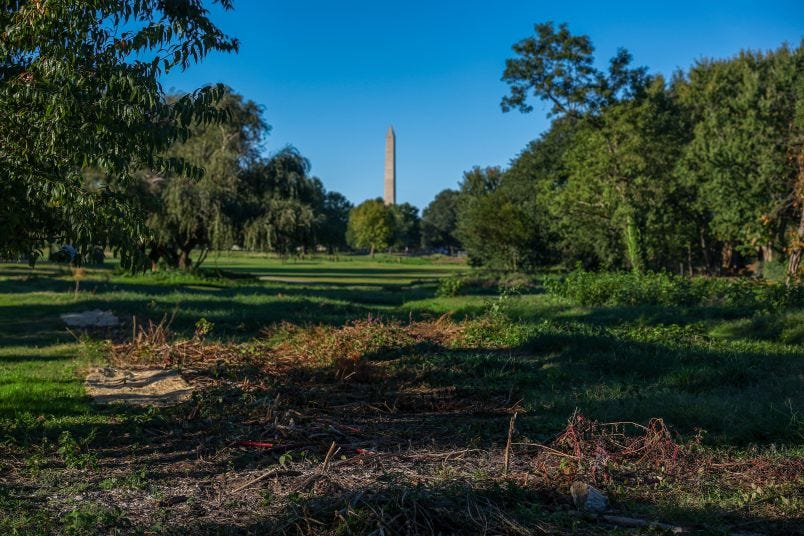
Until the open clash between Trump and Judge Reyes, I’d hesitated to cover the East Potomac Park case for a national audience because in some ways it’s a parochial D.C. issue and not of the same import as, say, the demolition of the East Wing of the White House, the blight of the Trump Triumphal Arch, the renamings of the Kennedy Center and the Institute of Peace, or the unspeakable painting of the intricate exterior of the grand Eisenhower Executive Office Building.
But there’s more going on here than a threat to one public golf course.
For those not familiar, it should be noted that while the public golf course within the historic park is at the center of the dispute, the identity, public use, and access to the park as a whole is at stake. The park features a heavily used paved waterfront loop for walkers, runners, and cyclists. It has a playground and picnic area. People fish, enjoy the views of the D.C. core and northern Virginia, and watch planes taking off and landing from DCA.
The park was created for the public by Congress in the late 19th century and then was built using fill on the tidal mud flats of the Potomac. The low-cost golf course, like two other public courses in D.C. on National Park Service land, has always catered to a broad clientele, trying to keep the sport accessible.
What makes this a national story beyond the clash with Judge Reyes is that the narrowing of public spaces is happening in parallel with the shrinkage of civic life under Trump. The concern is that Trump’s plan would make the golf course more exclusive and less accessible. It would alter the public nature of the park as it has existed for more than 100 years.
Must See
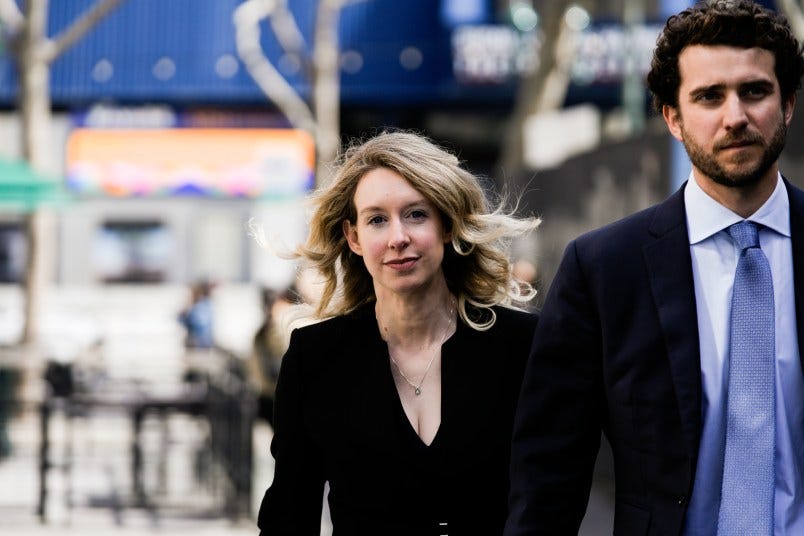
Let me join the chorus of reviewers urging you to go see Nathan Fielder’s “You Can See Everything.” It’s among the smartest documentaries I’ve ever seen.
I came to it unfamiliar with Fielder’s previous work and with only passing Wikipedia-level familiarity with the Theranos scandal.
If you’re a Theranos obsessive, you may come away disappointed. It’s not a Theranos documentary. It’s a psychological profile of Elizabeth Homes and of her romantic partner Billy Evans. While it may be tempting to make a judgment on Holmes’ culpability in the Theranos scandal based on Fielder’s work — and audiences probably come out of theaters chatting about exactly that — it would be a mistake.
The Theranos fraud, while inextricably woven into the documentary, exists separate and apart from it. Trials and depositions and financial filings and good investigative reporting already explore the fraud itself in great detail. This isn’t that. (If you feel the strong need for a villain in the documentary, Billy more than fills that role on his own — even though he had nothing to do with Theranos and didn’t first meet Holmes until after the company’s collapse.)
What really sets Fielder’s documentary apart is its acute self-awareness. It grapples openly with the range of challenges that confront documentarians and storytellers: the limits of objectivity, the nature of truth, the intrusive role of the observer, the inevitability of bias, the constraints of narrative forms. I’m barely even getting started. There’s a lot going on.
Fielder inoculates himself against the most obvious criticisms by confronting them as part of the story he’s telling. It gets super meta at times, but it doesn’t lose the thread of the story. I can’t say much more than that without spoiling it for you.
If you’re comfortable with uncertainty, bask in nuance, enjoy the challenge of juggling competing explanations, and can tolerate not having everything reduced to a single “answer,” you’ll delight in this artwork.
Everything he accuses others of is an admission
What ultimately is the goal here with the East Potomac Golf Links is an eventual incorporation into the trump Org.
golf-club portfolio, if only for "branding" purposes. trump has his evil, avaricious eye on the prize, let's make no bones about that, and the fact that DOJ is fronting his public steal, along with a subservient National Park Service, certainly elevates the hearings in Judge Anna Reyes courtroom. The regime has done the dirty on Judge Reyes' explicit court order to cease and desist any significant changes to the course site until and unless she approves...and as in countless immigration cases before federal judges nation-wide, the perps simply ignored Reyes' rulings with the usual and casual "fuck the judge" approach made memorable by the irascible and recently installed circuit-court judge, Emil Bove.
"Presumption of regularity?", ah, we hardly knew ye.