
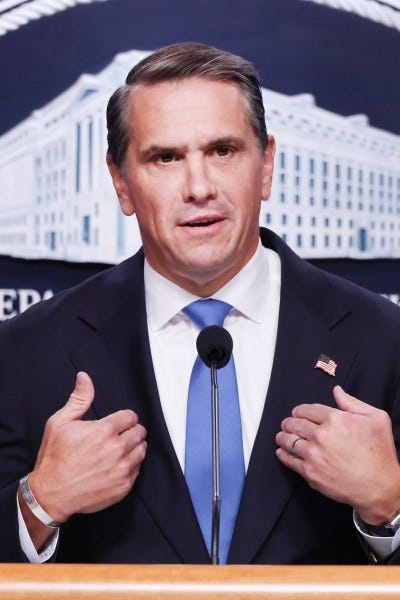
Blanche Targets Minnesota Judges
Under the pretext of an ethics complaint against all but one of the active federal judges in Minnesota, Attorney General Todd Blanche signaled yesterday that not only will the Trump administration continue to run roughshod over the judicial branch but that judges had better shut up about it.
The complaint filed by second and third highest ranking DOJ officials with the uber-right-wing 8th Circuit Court of Appeals is ostensibly about an admittedly unusual decision by the federal judges who bore the brunt of Operation Metro Surge to sit for an interview with the New York Times for a story that ran Sept. 17.
In the interview, the judges — including Patrick Schiltz who was the chief judge during the peak of the flood of mass deportation cases swamping the Minnesota federal court — defended the rule of law, provided a civics lesson on the role of the courts, and described the structural and institutional challenges they had faced. They refrained from talking about individual cases, but they did speak in broad terms about the habeas cases in general, Operation Metro Surge and the conduct of the Trump DOJ.
The complaint — signed by acting Deputy Attorney General Trent McCotter and Associate Attorney General Stan Woodward — accused the judges of pandering to the press and engaging in unethical behavior that “flagrantly violated” the canons of judicial ethics. It specifically called out Judge Schiltz and Judge John R. Tunheim — who were both quoted by name in the NYT article — for what it called “particularly egregious” misconduct.
The Trump DOJ asked the 8th Circuit to appoint a special committee to conduct an investigation of the judges for their allegedly improper behavior and to order Judges Schiltz and Tunheim to recuse themselves from any cases involving DHS.
The Trump DOJ getting on its high horse about legal ethics is a lot to take on its own. But it’s also striking that the complaint leans into what DOJ officials see as a friendly audience on the 8th Circuit. It emphasizes, for instance, the appeals court’s own decision upholding the Trump administration’s mass detention policy without bond — one of only two appeals courts to do so — in which it overruled the Minnesota judges.
Traditionally, Article III judges have been free to speak publicly on matters of judicial administration, the Constitution, democracy — civics, if you will. They have been free to lobby for more funding, better security protection, restructuring of the judiciary, and reform measures without running afoul of ethics requirements.
But the Trump DOJ — which has defied orders left and right, hidden its worst conduct behind unprepared junior lawyers, botched cases, fired huge numbers of experienced attorneys, and made a hash of the distinguished department — now wants to clamp down on the ability of judges to stand up against what may be the most sustained assault on the judiciary in the nation’s history.
SCOTUS Takes Up Mass Detentions
As expected, the Supreme Court will take up the Trump administration’s policy of mass detention without bond that the circuit courts have split on, but which dozens of judges in thousands of cases have found to be unlawful.
Renee Good’s Family Sues
The family of Renee Good who was shot and killed by ICE in January during Operation Metro Surge has filed two civil lawsuits against the Trump administration arising from her death.
Broadview Six Hearing This Afternoon
A federal judge in Chicago this afternoon will hear arguments over whether to conduct a further inqury into alleged misconduct into Trump’s DOJ’s handling of the grand jury in the Broadview Six case and the aftermath of that now-abandoned prosecution of ICE protesters.
As Bad as It Gets
The Supreme Court’s prior handling of the third-country removal case was already the most troublesome emergency docket case, Georgetown law professor Steve Vladeck argues, then came this week’s unexplained decision in the case:
“There have certainly been rulings on the emergency docket that I believe to be more clearly and obviously wrong on the merits. And there have been rulings on the emergency docket that have produced even more harmful effects domestically and/or to the separation of powers. But there’s something profoundly ugly about the D.V.D. case that, unfortunately, was on display again on Tuesday.”
Cannon Wiggles Out of Bind
Give her credit: Judge Aileen Cannon has gotten out of the pickle she was in on Volume II of former Special Counsel Jack Smith’s report. She struck a motion from FBI agents who investigated the Mar-a-Lago documents case and are now being targeted by the Trump DOJ seeking clarification on her order sealing Volume II. Her reason: The lawyers had failed to confer with the co-defendants in the underlying criminal case about their motion before filing it.
11th Circuit Stirs to Action
In the Volume II case which is on appeal, the 11th Circuit the appeals court rescheduled oral arguments yet again but moved them earlier for the first time after months of kicking the can down the road. Instead of January of next year they’re now scheduled for the first week of November. Nothing much going on that week.
Reflecting Pool Case Dismissed With Prejudice
Ruling that “no crime occurred,” a DC judge has ruled that the already-dismissed Reflecting Pool case against David Hearn should be dismissed with prejudice, meaning the Trump DOJ can’t bring the case against him again in the future.
Quote of the Day
“This event is the worst we’ve seen and unlike any other botched execution in the modern era. There is no precedent.”—Robin Maher, executive director of the Death Penalty Information Center, on last night’s horrific attempted execution of Christa Pike in Tennessee.
Pike remains hospitalized this morning. Gov. Bill Lee (R) has halted executions through the end of the year.
With respect to MM, no - absolutely no - credit to cannon. She does not get credit for breathing or for enabling evil.
The nation is tripling down on you trump.